Adapting to Community Life: A Dancing Rabbit Update
“So you just show up and everyone starts helping you build your house?”
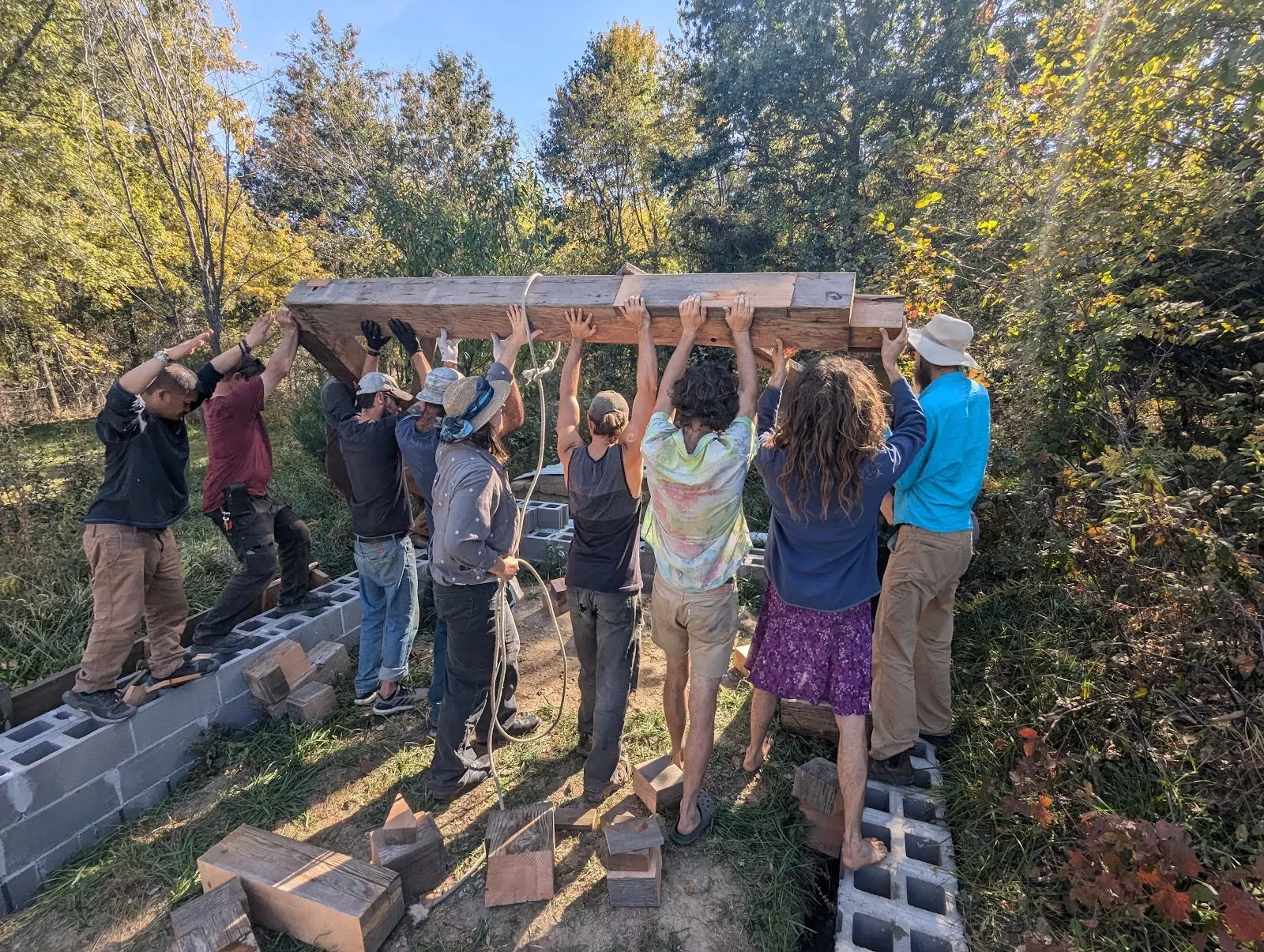
That was the question that was paramount in my mind for the past 20 years when I would visit the website for intentional community (ic.org) to fancifully admire pictures of clay-covered neo-hippies smiling, posed in front of some fresh construction, or, grimaced in a flex, pushing up a wall in unison. When I pondered the answer to this question, I came up with two assumptions: yes, you just show up and people start building you a house or no, you have to live there a while beforehand and your house just comes together organically.
Kelly here, with some lessons learned living in intentional community.
A DR work party raises a wall for Graham’s house.
In the first scenario, I felt like that seemed too easy to be practical, and even if it was that easy, my pathological altruism would prevent me from ever showing up with such a need. Ironically, when I did land at Dancing Rabbit, I was without a partner, with a baby and–as icing on the cake–a rapidly deteriorating ability to walk. Many people asked me what I needed during that time; how they as the community could help. I finally answered one day saying, “I just got here and have just begun forming relationships, how am I supposed to ask for so much help?”
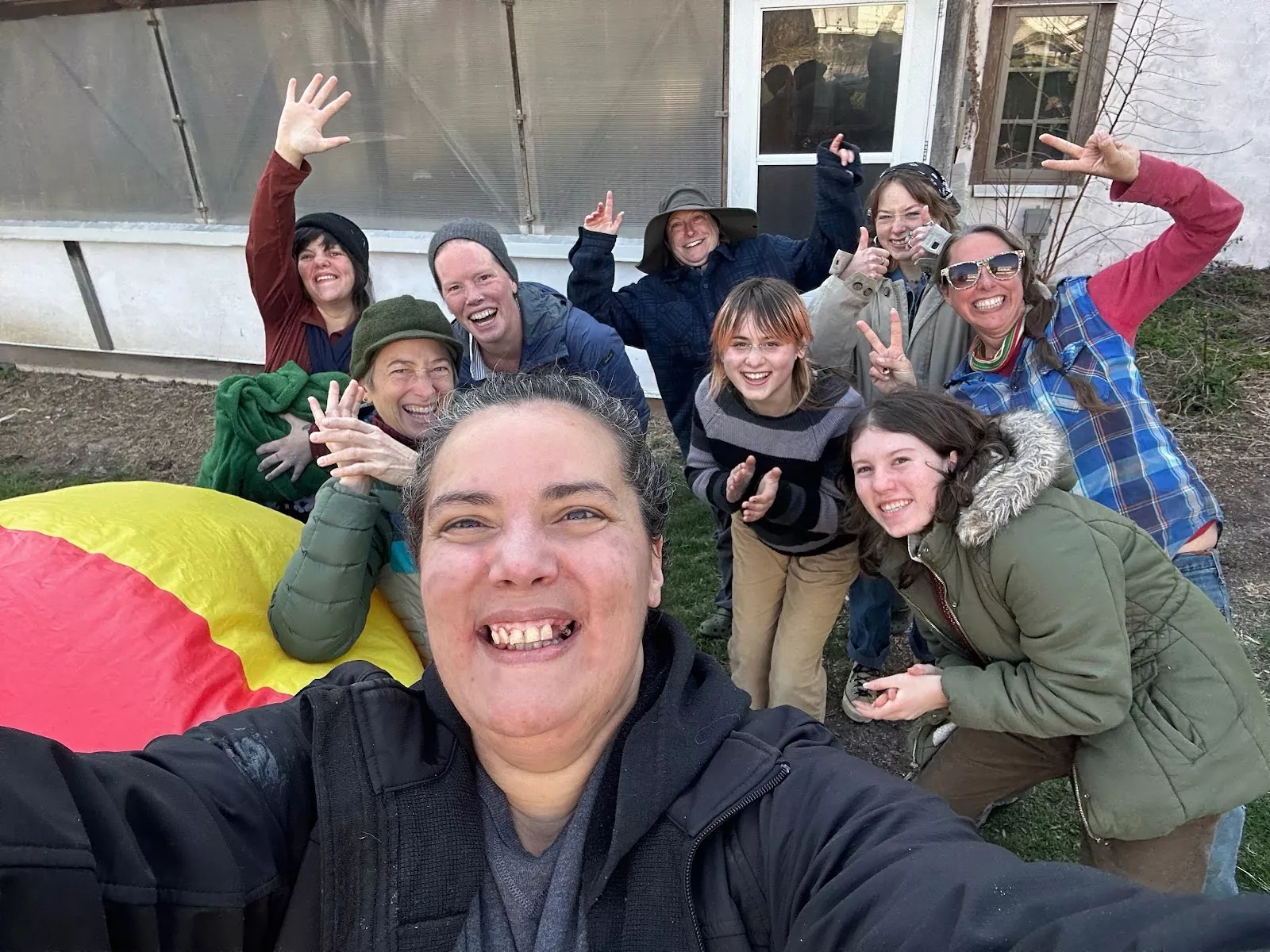
Kelly and some community neighbors. Photo by Kelly.
In my second imagined scenario, I knew that it would require a leap of faith on my part to figure out, and I am doing that. There are a lot of ways that modern human psychology is a relic of our former selves, when living in communities used to be the norm. Ruminating and worrying about social faux pas, or things we said in a conversation, or even our need for validation and acceptance, are all vestiges of a time when doing the wrong thing socially could mean life-threatening ejection from the group. I would be so interested to see what modern anthropologists would say if they came to Dancing Rabbit to observe and narrate our little colony for Ken Burns?
There are threads that run throughout each of our individual journeys to get here but there are also commonalities in our experience of settling in. Initially, it’s all rainbows and uni-goats. There’s a fun honeymoon period where you like everyone and everyone likes you. Settling in feels like you are an amorphous blob of slime just coming out of a mold and relaxing into a puddle. Then puddle edges start to overlap other people’s longer-established puddles so there is a tightening up a bit as you learn all your neighbor’s boundaries. This process teaches you that your neighbors are not all perfect and you learn to set your own boundaries and give feedback.
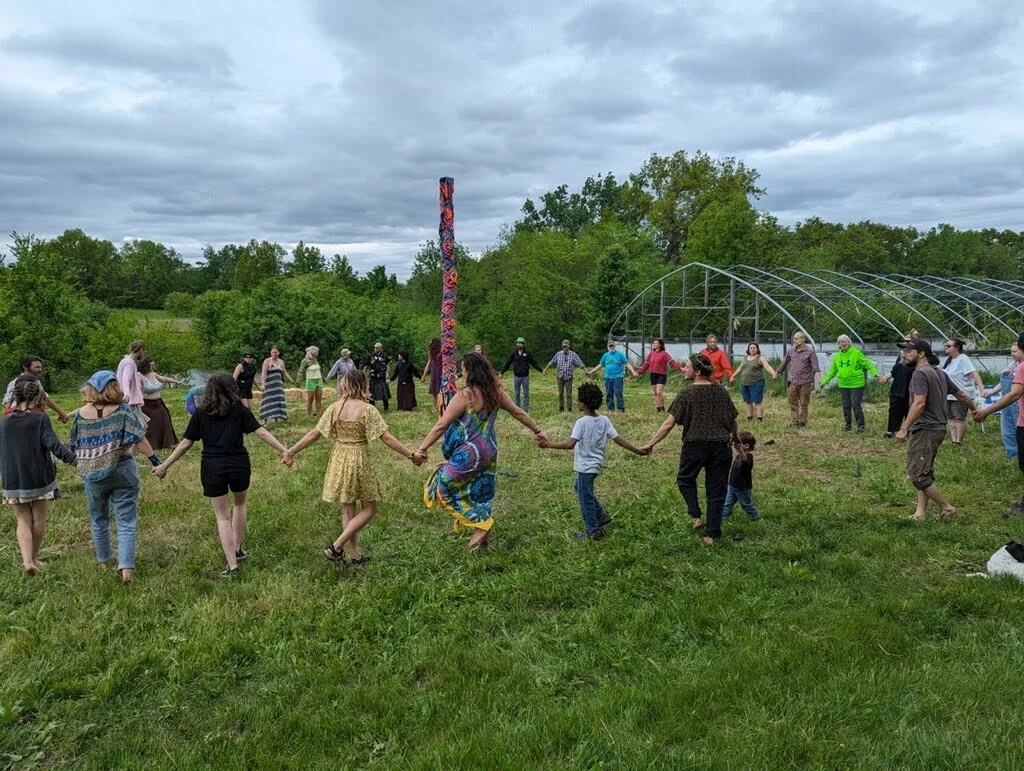
May Day circle at nearby community, Sandhill Farm.
Then suddenly one day, you realize the dreadful truth: that you are not perfect either. You have to be able to have people really see you and see your faults and comment on them. You have to be able to absorb and respond to tough feedback. Even if you feel like some of the feedback is unfair, you have to see that it’s their truth and adapt. You have to be able to swallow your pride. You have to do shadow work.
To survive the group you have to be able to tear down all of your walls before you can begin to build here.
Kelly Brandt is the house manager for Skyhouse, DR’s boarding house.