
The change of seasons and approach of winter leads me to reflect on the past year at Dancing Rabbit Ecovillage. Tony here, and for me this year was a special one, as it marked 20 years since I joined what was then just the earliest idea for an ecovillage.
So much has changed in these 20 years, in the 16 years since we bought our land, and even in just the last 12 months. It’s inspiring to see how much of our vision from years ago has come true and how much we have accomplished, even beyond our dreams.
Here’s a sampling of what we’ve been up to this year.
Gardens and Goats
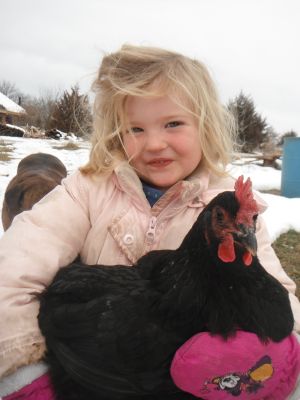
From the beginning we dreamed of the day when Dancing Rabbit would get all of its food from local sustainable sources. We aren’t there yet, but in 2013 we took some great strides towards that goal. Early in the year we approved a new agriculture policy, which allowed us to open up 18 acres of land for gardens and agricultural leases, on top of the 1.5 acres of gardens already in the village. We now have seven acres leased out to various groups and individuals for staple crops, a vineyard, a chicken ranch, and multiple permacultural food forest and agroforestry projects. No sooner had the land been leased than chickens, ducks, goats, sheep, and even a miniature donkey arrived.
Once you have farms, you of course need a farmers’ market. Growers from Dancing Rabbit, Sandhill Farm, Red Earth Farms, and further afield have been coming to sell their produce every Sunday this season, with abundant veggies, home grown shiitake mushrooms, plus other delights such as baked goods, kombucha, artisanal cheese, and homemade soap.
We also made progress on our goal of growing our own vehicle fuel. In partnership with our neighbors at Sandhill, we started a pilot project by planting one acre of organic canola, with the intention of pressing our own vegetable oil for both food and fuel. If all goes well we hope to scale up in the coming years and be able to run our vehicles on organic oil.
Driving on Sunshine
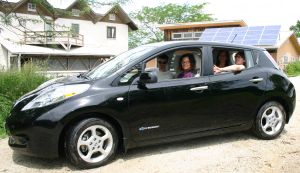
Speaking of vehicles and making our own fuel, Dancing Rabbit’s vehicle co-op is now the proud owner of a fully electric Nissan LEAF. The LEAF has a range of about 80 miles when its batteries are fully charged (from our own solar power co-op, of course). It has been the go-to car for all of our local trips, but we’re still using our biodiesel cars and truck for longer trips or when hauling a heavy load.
And while solar power and home grown fuel are pretty exciting, the real trick is that we share only four vehicles among 75 people, and we only drive them 160 miles per day — total — for the whole village (the same amount driven by 6 average Americans)!
Growing our local economy
People sometimes ask where the money comes from to buy things like an electric car, and in this case we can truly say that we made the money ourselves. Through our alternative currency, the ELM (Exchange Local Money) system, we were able to provide no-interest financing to our vehicle co-op to purchase the LEAF.
Over 15 years ago we started our alternative currency and now most of our internal transactions take place in ELMs, which convert one to one with dollars. You can pay rent and all of your utilities, buy all of your food with ELMs, and of course Thursday night pizza at the Mercantile cafe. We now have over 100,000 ELMs in circulation, which allows us to provide financing to our local businesses and non-profits, sort of like having our own credit union.
Sharing our skills
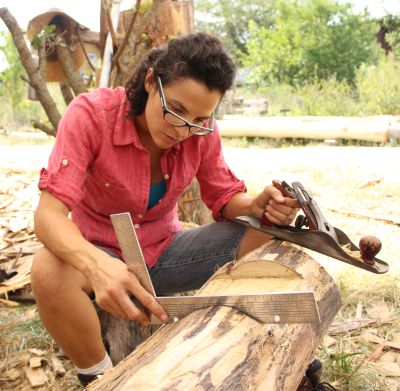
This summer Dancing Rabbit was home to a number of workshops with participants from around the country and the world. The most intensive was Ecovillage Education US, a 5 week course covering the whole breadth of sustainability, with a focus on training leaders to create communities that are resilient and ecologically sound. It was exciting to share our years of experience with a new generation of ecovillage activists, just as we learned from the successes and failures of communities from the 60s and 70s. We look forward to expanding the program next year with more students from the US and beyond!
Folks also came to Dancing Rabbit this summer to learn to build cob ovens or craft their own home with roundwood timberframing. Participants left these shorter courses with new skills and a taste of ecovillage life (and most likely some sand and straw in their pockets and cuffs).
Opening our homes
Another year, another highly successful visitor program! We hosted five groups, each of a dozen or so people, interested in learning more about Dancing Rabbit, with many of them seriously considering a move to our village. It’s always exciting for me when a new group is about to arrive and I wonder which of these friendly strangers might become a new neighbor and friend.
We also hosted dozens of tours for college classes, garden clubs, local folks, or people traveling just to see Dancing Rabbit. Our annual Open House in September had almost 200 attendees from as far away as Oklahoma, some of whom have already come back for another visit.
And of course it wouldn’t be summer at Dancing Rabbit without interns and work exchangers. We had a great crew this year, working hard on natural building and gardening projects, as well as helping out at the Milkweed Mercantile. We also hosted a team of three researchers who studied our ecovillage to measure how far we’ve come in reducing our ecological impact. They conducted interviews and collected data on electrical use, water use, driving, and food, and even weighed all of our trash and recycling for a month. As someone who loves data, I can’t wait to get the results of this ecoaudit next year.
Taking the ecovillage to the people
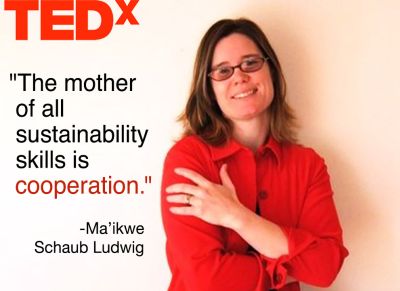
You don’t have to come to Dancing Rabbit to learn from us. This year roving Rabbits gave talks around the country, from New York to San Francisco to Omaha. Most exciting was the opportunity for our nonprofit’s Executive Director, Ma’ikwe Ludwig, to give a TEDx talk at Carleton College in Minnesota. Rabbits gathered at the Mercantile to watch the live internet stream and were thrilled by the quality of her talk and the great response from the audience. Her talk will soon be up on YouTube and we will send you the link as soon as we have it. If we get enough views it might be featured on the main TED Talk site, which would be a great way to spread the word about sustainability.
Building Green
From the day we bought our land Rabbits have been busy turning wood and straw and clay into homes for themselves and their families. Three new strawbale homes were started this year and are all enclosed for the winter, with finish work to be done next year. Quite a few of the 30+ buildings begun in earlier years had projects of varying sizes as well, with additions, renovations, screened in porches, root cellars, and finishing touches added, leading me to wonder if self-built homes are ever really finished.
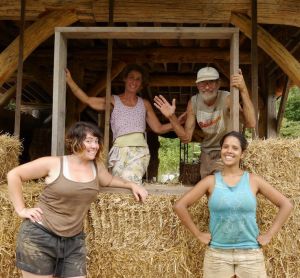
Our plans for a new Green Community Center moved along, though the pace was slower than we’d hoped (I bet you’ve never heard that before on a construction project, have you?). This flagship building will demonstrate both affordability and the ultimate in green building, and will feature nonprofit offices, a village commons, and a home for our education and outreach activities. We’ve been getting great support from engineers, architects, and landscapers as we finalize the design, and optimize systems for heating and cooling, and we’re looking forward to breaking ground in summer 2014.
Social infrastructure for the future
With growth and change being the only constants at Dancing Rabbit, we’re always building and planning infrastructure for the village of the future. That means more than just buildings, roads, and gardens. We also need social systems that can scale up as more and more new people join us.
Decisions at Dancing Rabbit have always been made by consensus, where members all met together to make major decisions. From the beginning we said we’d probably need a new system some day and that day has arrived. This year we made the big shift and selected our first Village Council to make decisions for us. Now our democratically-chosen council of seven members will make decisions by consensus on behalf of the group, streamlining our process and freeing up valuable time.
Fun and Games
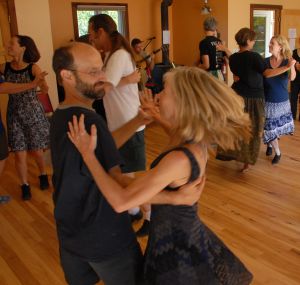
Of course, it’s not all hard work and long meetings at Dancing Rabbit — we have a lot of eco-fun. The Back Pedaler bicycle group went on a number of weekend trips in the area, visiting state parks, local vistas, and even the Amana Colonies. There were weekend dance workshops for both Contra and Blues Dancing with nationally known bands and instructors coming to play and teach.
The Milkweed Mercantile hosted a series of Artists in Residence who came and shared their artistic skills with the community. La Casa de Cultura was also home to house concerts performed by traveling musicians in genres from folk to electronica to opera and show tunes.
And, just like in the early days of Dancing Rabbit, we have our normal day to day fun of ultimate frisbee, sing-a-longs and song circles, word games, movie nights, talent shows, or just hanging out talking and watching the kids do all those cute things kids do.
Challenges
We’d be lying if we said life was without its challenges here in the ecovillage. One of the hardest parts of community life is when old friends leave our village. Nani and Dave and their kids left this year after four years in the community, and we are still feeling the loss. Long term members Ziggy and April had been planning to leave for a while, but even knowing it was coming doesn’t make it any easier now that they are gone. Their energy and creativity will be sorely missed.
We’ve also had our share of conflict, which we of course endeavor to resolve well, but we know we’ll never be perfect. For the most part it’s normal community issues — relationships shifting, challenges around money, or disagreements over how Dancing Rabbit can best fulfill our mission and support our members. Over the years we have developed our skills with a wide array of tools for dealing with conflict, including mediation, arbitration, and Restorative Circles. This latter is a new group process originating in Brazil that has been used in schools, families, and even as an alternative to the criminal justice system. We are still growing our skill with the process but so far it has been well received by many in the community.
Changing the World
Our vision at Dancing Rabbit is nothing less than a truly sustainable world, and while we work hard to create an example of a sustainable culture here in northeast Missouri, our efforts are aimed at much wider societal change. This year our educational non-profit took a huge leap forward with a shift from a primarily volunteer organization to one with paid staff. All positions are now filled and we are ready to ramp up our work of sharing our skills and inspiring others to create real change toward sustainability. We are seeking grants this winter to help us expand our educational programs and partnering with other non-profits to expand our reach.
Dancing Rabbit and you
Last year for our 15th anniversary we asked former members, interns, work exchangers, and visitors to let us know how their time at DR had changed their lives. They shared some great stories of skills learned and personal transformation.
Now we’d love to hear from you. Has DR inspired you? How have you changed as a result of our village’s work in the world? You can share your thoughts and experiences on our website, and read what others have shared as well.
It’s been a great year (and a great twenty years!) and we thank you for being part of making Dancing Rabbit and a sustainable future possible.
Tony Sirna